PLMA e-Scanner - March 2026

Industry News
A mosaic of markets: Private label strengthens its position across Europe

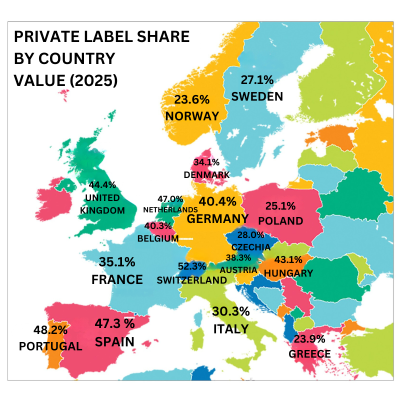
Private label continued its strong momentum across Europe in 2025, reinforcing its role as a strategic pillar for retailers and a key growth engine for manufacturers. According to to the latest data from NielsenIQ, total private label sales across 17 monitored European markets reached €387 billion, up €15.3 billion, giving store brands a 38.8% share of the grocery market.

Growth once again outperformed the broader grocery sector. Private label turnover rose 4.1%, compared with 3.2% growth for the total market and 2.7% for manufacturer brands. In volume terms the gap was even clearer: private label unit sales increased 1.3%, more than double the overall market’s 0.6%, while branded products saw a slight decline.

Inflation and heightened price awareness continue to influence shopper behaviour, but value alone does not explain the success of private label products. Retailers have increasingly invested in innovation, product quality and sustainability to strengthen the value proposition of their brands and build consumer trust. According to research by Euromonitor International, retailers are embedding sustainability and product innovation into private label development to position their own brands as credible and value-driven competitors to national brands.

Despite this progress, Europe remains a highly diverse landscape. Private label now exceeds 50% market share in Switzerland, while in the other countries value shares range from 48.2% in Portugal to 23.6% in Norway. In 12 of the 17 countries analysed, private label grew faster than branded goods in 2025. The strongest growth markets were Portugal, Hungary, Norway, Spain and Greece, highlighting opportunities in markets where retailer brands are still expanding.

Performance also varies by department. Private label growth was particularly strong in health care, where sales rose 13% in value and 10% in volume, albeit from a small base. Meanwhile, fresh and perishable foods continued to perform well, reflecting rising consumer demand for healthier and more transparent food options.

Consumer perception is also shifting. Surveys show that 96% of shoppers consider private label essential to their shopping basket, with most believing store brands now match national brands in both quality and sustainability.

The overall picture is clear: Europe’s grocery markets may differ widely in structure and maturity, but across this mosaic of markets, private label is firmly embedded and continuing to grow.

To actually see, experience, and exchange ideas about the latest developments in private label make sure you attend the 2026 “World of Private Label International Trade Show in Amsterdam on 19-20 May, and the pre-show seminars on 18 May. Click here to register.

“A mosaic of markets: PLMA’s 2026 Report on the status of private label across Europe” will soon be available, check the website www.plmainternational.com.


New purchasing alliance in Portugal

Connexio is a newly announced purchasing alliance formed by Auchan Retail Portugal and Grupo Mosqueteiros (the owner of the Intermarché banner in Portugal) to strengthen supplier negotiations and improve competitive positioning in the Portuguese grocery market. The initiative was revealed in early March 2026 as a central services platform focused on streamlining and jointly negotiating general terms with key suppliers.

Connexio’s core mandate is to generate scale and operational efficiencies by reducing transactional complexity and enhancing supplier engagement. While it will handle overarching negotiation frameworks, each partner retains full autonomy over pricing, assortment decisions, promotional strategies and individual ordering.

The alliance reflects broader market pressures in European food retail, where scale and supply chain optimisation increasingly influence competitiveness. 

Can loyalty card data assist in early cancer detection?

Retail loyalty programmes may soon play an unexpected role in healthcare. Researchers in the UK are exploring whether everyday shopping data from major retailers could help identify early warning signs of cancer.

A new study led by Imperial College London is analysing purchase histories from participants who use the Tesco Clubcard and Boots Advantage Card programmes. By comparing the over-the-counter medication purchases of people later diagnosed with cancer against those of a healthy control group, researchers hope to uncover subtle shifts in buying behaviour that may precede diagnosis.

The research builds on earlier findings supported by Cancer Research UK, which identified differences in purchasing patterns for pain relief and indigestion remedies among women who were later diagnosed with ovarian cancer—sometimes as early as eight months before clinical detection.

The new phase expands the scope to ten cancer types, including colorectal, pancreatic, liver and ovarian cancers. Many of these conditions initially present with mild or non-specific symptoms such as bloating, fatigue or indigestion. As a result, individuals often turn to self-care products before seeking professional medical advice, creating a potential behavioural signal within retail data.

If the research proves successful, scientists hope to develop a system that monitors consenting shoppers’ purchasing patterns and flags potential health triggers, encouraging earlier medical consultation.

The initiative demonstrates how partnerships between retailers, healthcare researchers and charities could unlock new public health insights from everyday consumer behaviour, while raising important questions around privacy, ethics and data governance in the evolving data economy.

Finland’s private label proposal could have cross border impact

Recent policy deliberations in Finland are capturing attention across the European FMCG landscape, as Helsinki prepares to advance legislation that would limit supermarket private label products in a bid to protect smaller domestic food producers. Under a draft amendment to the Finnish Food Market Act, the government is considering capping the share of own brand products on shelves and restricting their unlimited expansion — aiming to secure more shelf space and stronger negotiating power for independent manufacturers. The draft is expected to be introduced to Parliament imminently, with possible implementation in 2026–27 after consultation and parliamentary review.

Market structure is central to the policy rationale. Finland’s grocery sector is highly concentrated: the domestic S Group and Kesko’s K Group together command over 80% of the national grocery retail market, making the sector effectively an oligopoly. S Group alone holds nearly half of all grocery sales, with K Group accounting for around one‑third. The German discount retailer Lidl trails with under 10 % of the market. This concentration amplifies the negotiating power of major retailers vis‑à‑vis food suppliers, a point highlighted by farmers and SME producers advocating for regulatory intervention.

Proponents of the Finnish proposal argue that curbing private label dominance could rebalance buying relationships and strengthen competition. However, critics like consumer associations and retail advocates warn such restrictions could have unintended consequences. Private label offerings are a key source of value for price‑sensitive consumers in an environment where food prices have risen sharply, and reducing their availability could further drive up the checkout receipt. These concerns are resonating in public debate, especially as Finland heads toward general elections, raising uncertainty about the proposal’s prospects.

Across the Gulf of Finland, Estonian industry voices are watching closely. While Estonia currently has no formal policy to restrict private label growth, the Estonian Food Industry Association has voiced concern over the expanding share of own brand goods, especially in certain categories, and the competitive pressures this creates for domestic producers. They caution that if Finland’s protectionist approach gains traction as a European trend, it could influence policy thinking in Estonia and other markets.

These developments underscore a broader tension between cost‑efficient own brand strategies and evolving policy debates around market concentration, fair trading practices and agricultural resilience. How regulators balance these interests, and how retailers respond, will be an important industry story to follow in the months ahead.

Chinese e-commerce challengers set sights on Europe

A new wave of Chinese e-commerce platforms is reshaping the competitive landscape for European retailers and manufacturers. Companies such as Temu, AliExpress, Shein, and JD.com’s European platform Joybuy are accelerating their push into the region, bringing new price dynamics, supply chain models and consumer expectations.

The first wave of entrants built their growth on ultra-low prices and direct shipping from Chinese factories to European consumers. By sending millions of small parcels directly to households, these platforms were able to cut out intermediaries in the retail supply chain and benefit from customs exemptions for low-value goods, helping them scale rapidly across Western markets.

However, the model is increasingly under regulatory scrutiny in Europe as authorities examine product safety, competition and the role of foreign subsidies. From 1 July 2026, parcels valued under €150 entering the EU will face a flat €3 customs duty. This measure is temporary (2026–2028) while the EU prepares a broader customs reform.

At the same time, Chinese platforms are adapting their strategies. While Temu and Shein continue to rely heavily on cross-border shipments, players like JD.com are pursuing a more localised approach. Its Joybuy platform, currently being piloted in several European markets including the UK, Germany and the Netherlands, aims to replicate JD’s domestic model with local warehousing, faster delivery and partnerships with established brands, including Dutch Superunie own brand G’woon, across categories such as groceries, beauty and household essentials.

This development also reflects changing dynamics in China’s own digital economy. As growth slows and the era of heavy platform subsidies fades, some Chinese e-commerce companies are seeking new international markets to sustain growth and improve profitability.

EU closing in on harmonised sorting labels for FMCG packaging

Brussels is progressing towards a unified system of sorting labels on consumer packaging across the European Union, with implications for manufacturers, retailers, designers and packaging producers. Under the Packaging and Packaging Waste Regulation (PPWR), the European Commission is obliged to adopt an implementing act establishing harmonised consumer sorting instructions by 12 August 2026. The aim is to simplify recycling and reduce fragmentation caused by divergent national systems.

In January 2026, the European Commission’s Joint Research Centre (JRC) published a detailed technical proposal outlining a harmonised waste sorting label system. This evidence‑based document proposes a common visual language designed to help consumers identify correct disposal streams and to align packaging labels with collection infrastructure.

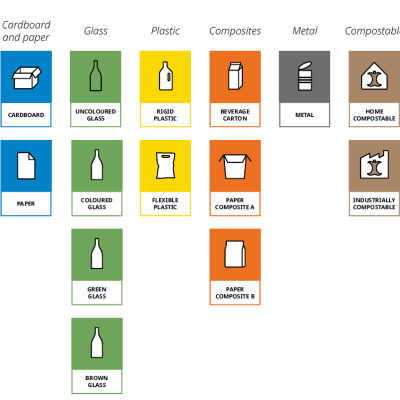
The system combines pictograms, colours and text and sets out specifications for label dimensions, placement and accessibility. Under the proposal, each label would indicate one material category, meaning composite packaging might require multiple symbols. Alternatives such as QR codes are also discussed for packaging where physical labels are less feasible.

Industry reactions have been mixed. Some trade associations argue that extensive use of colour and language on labels could undermine harmonisation and reintroduce barriers to the internal market, contrary to PPWR objectives. They advocate simpler, pictogram‑centred systems to reduce compliance costs and cross‑border complexity.

For businesses planning packaging redesigns beyond 2026, early consideration of the forthcoming harmonised label is increasingly advised. With the visual system largely defined and a formal implementing act expected later this year, companies that defer preparation may find themselves at a disadvantage.

PLMA Live.eu
Innovation, Sustainability Shape Future of Single-Serve Capsule Market

Euro Caps' rise to global leadership in coffee capsules accelerated after
major consumer award wins in 2013 – 2014 and an early move into private label with a leading European retailer.

Nils Clement, CEO and co-founder, says the recognition validates the company's quality-first strategy. He points to bold reinvestment, entrepreneurial agility, and continuous innovation – including fibre-based, compostable capsules and matcha tea launches – as key growth drivers.

In the stores

Co-op Wholesale is launching more than 200 new own-label products in the UK, as part of its upcoming 500-product strong ‘Summer at Co-op’ campaign. The range also includes limited edition summer-only products.

Aldi reaches 500 stores in Spain, a growth of more than 50% in five years. Nine out of every ten items on Aldi’s shelves are own brands. 80% of its assortment are Spanish-made products.

Kaufland is giving its more than 4,500 own brand products a uniform design. A white corner with the red Kaufland "K" will be featured on all products for better visibility on the shelves. The brand name K-Take it Veggie will change to K-Plant Based and the premium K-Favourites will become K-Gold Edition.

Plus introduces a delivery subscription for its regular online Dutch customers. Customers can subscribe monthly, quarterly, or annually, with the annual weekly subscription being the most economical (€2,54 per week).

Alcampo focuses on innovation and brought 536 new products to market in 2025. There were additions in categories such as fresh produce, healthy and sustainable, pet supplies, cosmetics, and cleaning products.

Deliverer Wolt is expanding its online supermarket offering by several hundred items. It also adds a freshness guarantee: If a product does not meet expectations, the company will issue an immediate refund.

During 2025, Consum launched more than twenty new own brand products and implemented 108 product improvements, with better nutritional profiles, reducing sugars and allergens, incorporating functional ingredients, and expanding product ranges adapted to specific needs.

Iceland is opening supermarkets in UK prisons to help prisoners prepare for retail careers after their release. The stores are entirely staffed and run by serving prisoners, they learn core retail skills like stock taking, handling deliveries and managing inventory.

Coop Switzerland is expanding its affordable private label “Prix Garantie” from the current 1,500 to up to 2,000 items. The company also intends to consistently pass on any decline in raw material prices to its customers.

Auchan has introduced a new biodiversity labelling for its private label products in France. The label indicates that the cultivation methods of the fruit or vegetable help preserve and restore biodiversity.

Boots is testing an in-store service in 17 stores that offers a consultation with a pharmacist to determine if they are eligible to get a weight-loss jab prescription. 

Migros launches the “Save Food” initiative, it sells attractively priced Swiss fruit and vegetables that were previously not generally included in the standard range due to deviations from the norm.

Leclerc is holding its fifth national job fair, "The Big Meeting," and invites candidates to meet the retailer in nearly 500 stores across France. Candidates can come with or without a resume, to meet recruiters for an initial ten-minute interview.

Market research
From value to innovation: private label in Europe

Private label in Europe is evolving beyond value positioning as retailers leverage trend‑driven innovation, partnerships and responsible development to enhance differentiation and competitiveness, according to IGD.

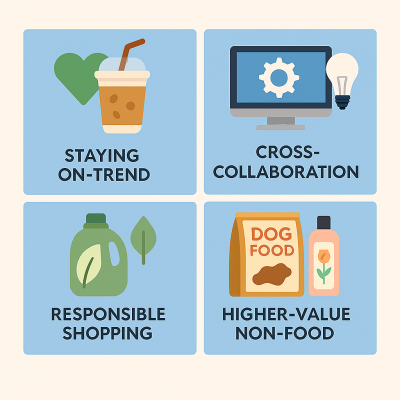
Four global private label trends are shaping the market. First, staying on-trend, with health and lifestyle influencing product development. Examples include Aldi Nord’s lower-sugar Barissimo iced lattes in Germany, which combine wellness, taste and convenience.

Second, cross-collaboration is accelerating innovation through technology partnerships. Tesco’s work with AI platform Keychain streamlines design, sourcing, compliance and manufacturing, reducing complexity and shortening launch times.

Third, responsible shopping is driving nutrient-dense and sustainable products. dm’s Denkmit laundry detergents utilise CO₂-based surfactants, while Co-op and M&S are introducing GLP‑1-friendly, high-protein and high-fibre products to support health-conscious consumers.

Finally, private label is expanding beyond food into higher-value non-food categories. Sainsbury’s is growing its premium dog food range, and Superdrug has invested in own brand beauty and skincare, proving private label can offer credible alternatives to established brands.

For suppliers, these trends present opportunities to influence category direction. Retailers seek partners who can deliver trend aligned products, accelerate development, support responsible innovation, and provide high performance non-food solutions. Agility, technical expertise and insight will be key to shaping the next phase of private label growth in Europe.

Many Germans abandon brand-name products for private label

A recent study by management consultancy Simon-Kucher highlights a shift in German grocery shopping habits, with brand name products increasingly perceived as overpriced. Conducted in January 2026 alongside market research institute Appinio, the survey of 1,000 Germans found that over half see no clear advantage in branded goods, while 39 percent even accuse brands of profiteering.

As a result, 42 percent of respondents rely primarily on private labels for their weekly shopping, with 14 percent almost exclusively purchasing them. The trend is particularly pronounced among lower-income consumers, of whom nearly a quarter largely avoid branded products, compared with just 11 percent of higher earners.

Price is becoming the dominant factor in purchasing decisions, with 59 percent expecting it to grow even more important in 2026. Conversely, sustainability and ethical considerations are losing influence, reflecting a pragmatic shift in consumer priorities.

Simon-Kucher emphasises that the move towards private labels is structural rather than cyclical. Even if branded and private label prices were equal, 81 percent intend to stick with retail brands.

Spanish food retail hit record social media engagement last year

The Spanish food retail sector is experiencing unprecedented digital engagement, according to Acceso’s 2025 Social Intelligence report. The study analysed over 1.9 million mentions from more than 500,000 users, generating 203 million interactions, highlighting the growing importance of online reputation and marketing for leading retailers.

Not all platforms perform equally. While Google My Business, YouTube, and X capture the largest share of mentions, TikTok and Instagram deliver far higher amplification. TikTok, with only 114,700 mentions, produced over 160 million interactions, while Instagram achieved 27 million interactions from 39,100 mentions. Women accounted for 71 percent of participants in these digital conversations.

In terms of brand visibility, Mercadona dominates with just over 1.1 million mentions, followed by Carrefour (412,000), Lidl (346,500), Aldi (157,841), and Dia (33,641). The study also reflects evolving consumer preferences: discounters are increasingly popular, with loyalty influenced by services such as in-store bakeries, fresh fish preparation, and extended opening hours.

Social media is also shaping product innovation. Seasonal, limited-edition, and “viral” items, like pistachio crisps or truffle sauces, gain traction through TikTok and Instagram, alongside a growing appetite for ready-to-eat meals and health-focused products, including high-protein, vegan, and gluten-free options.

PLMA News
Understanding your customer on an emotional level

Too many marketing decisions are still driven by what the company likes or wants—rather than by what its customer actually values. While many organisations proudly claim to be customer-centric, the reality often tells a different story. In marketing and sales, this disconnect can be a costly business mistake.

Ask a consumer why they buy a particular product and you are unlikely to get a reliable answer. Often, people simply don’t know—or they rationalise their choice after the fact. In truth, purchasing decisions are largely driven by emotion. This is where effective marketing and sales succeed: by understanding and triggering the emotions that influence consumer choice.

Store design, product layout, colours, fonts, language and messaging all play a role in shaping emotional responses. When used well, these elements attract customers and build preference. Crucially, this applies not only to end consumers, but also to B2B customers. The same emotional drivers are at work, and the same marketing and sales tools can be applied.

However, not all customers are the same.

That is why Buylogic has developed a customer segmentation model designed specifically for marketing professionals. Unlike traditional segmentation approaches based on demographics such as age, gender, income or geography, this model is rooted in psychology, market and empirical research, communication theory and neuroscience. It focuses on what truly motivates customers to buy at an emotional level—whether they are consumers or B2B decision-makers.

On 25 March, from 12:30 to 13:30 CET, Sanne Dollerup of Buylogic will host an online webinar exploring emotional customer segmentation and the emotional drivers behind purchasing decisions.

The session is part of PLMA’s Lunch & Learn series and is free for PLMA members and retailers. To request a registration link, click here.

Events

PLMA’s Lunch and Learn webinars are designed exclusively for private label manufactures (PLMA members), retailers and wholesalers who wish to expand their knowledge of the private label business. PLMA organises several webinars a year, each focusing on different topics. 


PLMA’s 2027 World of Private Label will be held at the RAI Amsterdam Convention Centre on Tuesday 25 and Wednesday 26 May. During two days, the show will be the focal point of the largest concentration of private label professionals in the industry. 

March 2026