Private Label Reinforces Its Strong Presence Across Europe
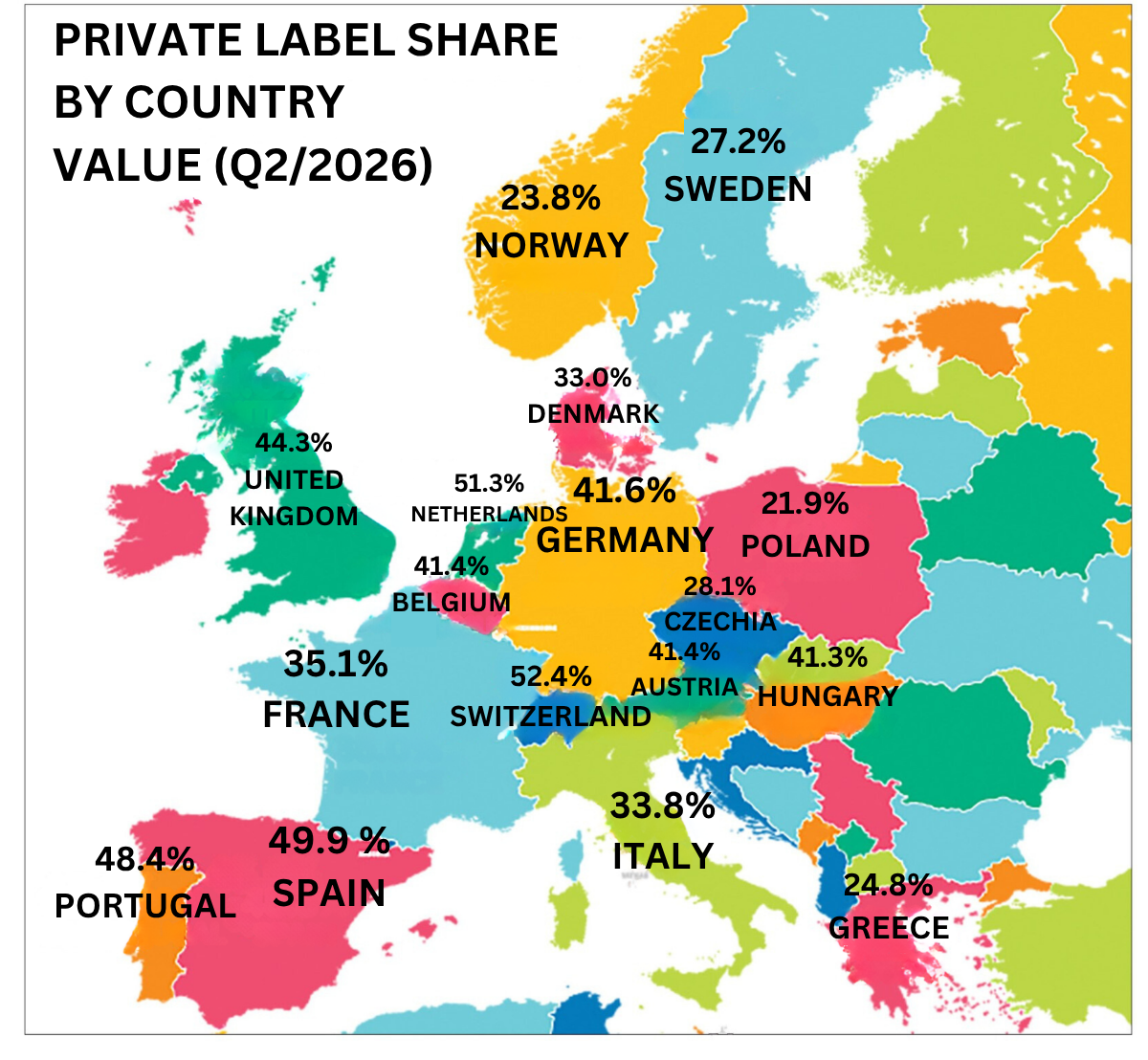
The private label share across 17 countries in Europe is growing according to the data of NielsenIQ. The share grew to 39.5% based on MAT W28 2026 (+0.22%pnt versus MAT W28 2025). NielsenIQ surveyed 17 markets for PLMA’s 2026 International Private Label Market Report update and noticed an increase for retail brands in 11 out of the 17 countries.
European markets remain some of the biggest Private Label markets globally, 11 markets have a private label share position above 30%, and 8 markets are above 40% of Private Label share.
The highest growth countries in private label share are Austria (+1.1%pnt), Portugal (+0.9%pnt), Spain (+0.8%pnt), and United Kingdom (+0.3%pnt). The country with the highest share across the 17 countries tracked is Switzerland. The share of Switzerland is 53.0%, which makes it one of the two countries with a share higher than 50%, with the other one being The Netherlands with 51.3%.
Europe’s largest markets, Germany, United Kingdom and France, have a collective Private Label share of 41.1%, this share grew +0.2%pnt vs last year. The highest share growth for the largest markets is visible in Confectionery & Snacks and Frozen Food.
Spain and Portugal gained Private Label share by +0.8%pnt, the highest share growth is visible in Health Care which grew +2.7%pnt. In Spain and Portugal Alcoholic Beverages (-0.15%pnt) and Pet Food (-0.13%pnt) are declining in share.
In Belgium and The Netherlands, the private label share decreased by -0.2%pnt. The highest declining category is Home Care (-1.2%pnt), Pet Food (-0.9%pnt), and Frozen Food (-0.7%pnt). Confectionery & Snacks (+0.2%pnt) is the highest growing categories.
The Scandinavian countries also decline in the Private label share (-0.2%pnt). The highest declining category is Pet Food (-0.6%pnt) and Perishable Food (-0.6%pnt). Health Care (0.5%pnt) and Confectionery & Snacks (+0.4%pnt) are the highest growing categories.
In Eastern Europe the private label share is stable (-0.02%pnt). The highest growth in private label share is visible in Ambient Food (+1.0%pnt), Health Care (+1.0%pnt), and Frozen Food (+0.3%pnt) while Pet Food (-1.9%pnt), and Non-Alcoholic Beverages (-1.1%pnt) decline the fastest.
According to NielsenIQ’s data, Confectionery & Snacks, Food Ambient, and Home Care are the top 3 categories of Private Label value share with an average of 38.1% representing, in total 316 billion Euros across the 17 European countries tracked. Overall, the private label sales grew with 10.7 billion euros across the 17 European countries tracked.
Private label products encompass all merchandise sold under a retailer's brand. That brand can be the retailer's own name or a name created exclusively by that retailer. In some cases, a retailer may belong to a wholesale group that owns the brands that are available to only the members of the group.
Major supermarkets, hypermarkets, drug stores and discounters offer products under the retailer's brand. Private label covers lines of fresh, canned, frozen, and dry foods; snacks, ethnic specialties, pet foods, health and beauty, over-the-counter drugs, cosmetics, household and laundry products, DIY, lawn and garden, paints, hardware, auto care.
For the consumer, private label represents the choice and opportunity to regularly purchase quality food and non-food products at savings compared to manufacturer brands, without waiting for promotional pricing.
Private label items consist of the same or better ingredients than the manufacturer brands, and because the retailer's name or symbol is on the package, the consumer is assured that the product meets the retailer's quality standards and specifications.
Manufacturers of private label products fall into three classifications:
• Large manufacturers who produce both their own brands and private label products.
• Small and medium size manufacturers that specialise in product lines and concentrate on producing private label almost exclusively.
• Major retailers and wholesalers that operate their own manufacturing plants and provide private label products for their stores.